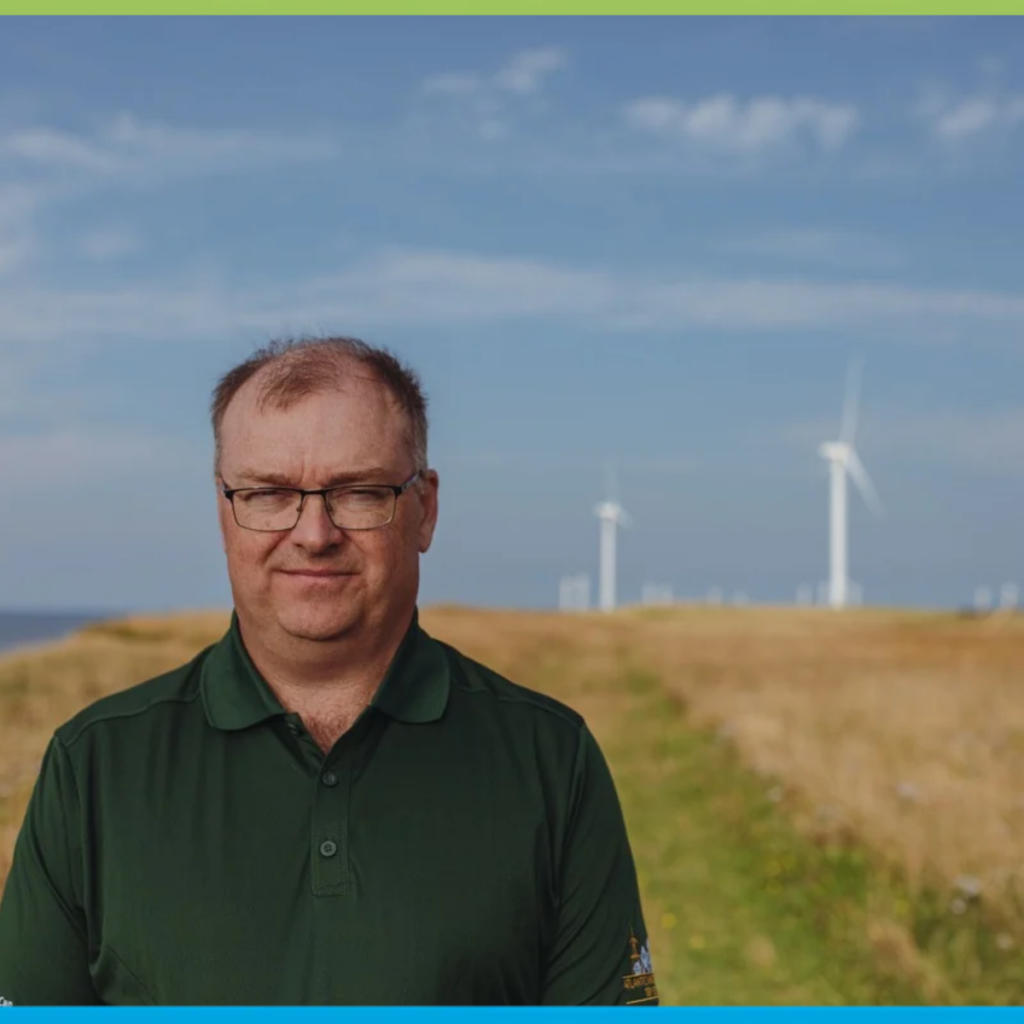
On a really windy day, Prince Edward Island can produce more electricity from wind than the whole Island uses. That raises a simple question with a surprisingly interesting answer: where does all that extra power go?
To find out, I spoke with Scott Harper of the Wind Energy Institute of Canada (WEICan) at North Cape, on the northwestern tip of PEI. WEICan has been testing wind energy there since 1981, when it was known as the Atlantic Wind Test Site. Today it is a not-for-profit research centre with a staff of 12 to 14 people, and it is also an independent power producer that runs its own 10-megawatt wind farm.
Here’s what I learned about how a small island runs on so much wind, and what other grids can learn from it.
How PEI became a wind leader
The Island’s wind story started with a search for a test site. In 1981, Canada was looking for a place to test wind turbines, and PEI was already known for its strong winds. Through the 1980s and early 1990s, North Cape tested some of the largest early-stage turbines in the country and built up a detailed record of just how strong the wind resource was.
By the late 1990s, PEI had some of the highest electricity rates in the region. It had almost no generation of its own, beyond some backup diesel, and relied on the mainland for its power. Wind was a way to take back some control.
The province started small, with eight 660-kilowatt turbines at North Cape in 2001. That project doubled in size in 2003, the same year Vestas installed a 3-megawatt machine that was the largest wind turbine in North America at the time. Government, municipal and private projects followed over the next decade, and renewables climbed past 25 per cent of the province’s power.
“We started small, eight 660-kilowatt turbines right here in North Cape outside our window in 2001.” — Scott Harper, Wind Energy Institute of Canada
So where does the extra power go?
The short answer is New Brunswick. PEI is an island on the map, but not on the grid. Submarine cables tie it to the mainland, and Maritime Electric and NB Power work closely together, with control desks tracking the flow minute by minute.
“We’re physically an island, obviously, but electrically we are grid connected to the mainland.” — Scott Harper
Scott gave a real example from the morning we spoke. PEI was using about 230 megawatts and generating about 120 megawatts from wind, so the cables brought in the remaining 110 from the mainland. On a windier day with lower demand, the flow reverses. If the Island makes 20 megawatts more than it needs, that power flows into New Brunswick.
Storage plays only a small role so far. WEICan once ran a 1-megawatt, 2-megawatt-hour battery and now has a much smaller one, and Summerside has its own battery project. A recent fire at the Summerside site has the industry watching closely for the root cause. In Scott’s words, PEI is “dipping our toe in the water” on storage.
The bigger pressure is demand. Heat pumps and population growth have pushed the Island’s peak demand past 400 megawatts, and Scott says load has been growing faster than renewable generation. That raises questions about cable capacity, and about whether neighbouring provinces will have power to spare when PEI needs it, or room to take it when PEI has too much.
“Our load’s been growing faster than our generation of renewables has been growing over the last number of years. So we’ve got a little catching up to do.” — Scott Harper
Lessons for small grids
For several years, WEICan coordinated the Utility Forum, a Natural Resources Canada initiative that brought system operators from every provincial utility together a couple of times a year to compare notes. Scott says WEICan’s value was that it was neutral: a nonprofit research group that also knew what it meant to deal with a turbine trip at 2 a.m.
One idea they tested could change how wind is used. Wind has traditionally been “take or pay”: turbines produce whatever the wind gives, and the grid absorbs it. WEICan ran demonstrations where it deliberately held its wind park below full output, so extra power was ready when the utility needed a quick boost.
Scott sees that kind of flexibility becoming more useful in Canada as demand grows and transmission lines get congested. It works alongside efforts to shift customer demand to times when power is cheaper or more plentiful.
“If the grid goes down, it’s a major, major, major issue. So they need to be cautious, and they need to understand exactly how these things can work.” — Scott Harper
Inside the turbine
The question Scott hears most often is whether turbines spin faster when the wind blows harder. They don’t. Turbines are geared to keep the blade tips at an efficient speed, and Scott compares it to an old 10-speed bike: you keep your feet turning at the same pace, but you put more energy behind each push.
The scale also surprises people. WEICan’s 2-megawatt turbines sit on 80-metre towers with 90-metre rotors, and each one holds more than 1,000 litres of lubricant. That’s why WEICan works with ExxonMobil on next-generation lubricants that last longer. The goal is fewer costly oil changes and less waste.
“There’s over a thousand litres of lubricant in that turbine. It’s a big mechanical device with a lot of gears, with hydraulics and greases.” — Scott Harper
The turbines get two major maintenance visits a year, in spring and fall. Between visits, the data never stops. WEICan collects about 8,000 data points every second from its turbines, weather station, battery, substation and 100 kilowatts of solar panels, and it has a decade of that history stored.
When a part fails, the research team looks back through the data for the early warning signs. Researchers are now interested in using AI on WEICan’s 15 years of operating history to help maintenance teams catch problems sooner, at WEICan and across the industry.
What's next for WEICan
WEICan’s wind park is now 15 years old, and the team plans to run it for at least another 10. It is also starting to plan something new: a next-generation wind park built around fresh research opportunities. WEICan is asking utilities, government research programs and academic partners what they would most like to study, and expects to work through those conversations over the next year or two.
“You don’t build a new wind park overnight. It’s multiple years of planning and effort, but it’s exciting. It’s always nice to build things.” — Scott Harper
Listen to the full conversation
Hear the whole episode, including the story behind North Cape’s early turbines and why ExxonMobil is a wind research partner.
- Listen: https://www.buzzsprout.com/2147733
- Watch: https://www.youtube.com/watch?v=o-qEPfBdjTs
- Learn more about WEICan: weican.ca
If you enjoyed this conversation, share it with someone who’s curious about where their power comes from, and subscribe to Reimagined Energy so you don’t miss an episode.
Stay Plugged In
Enjoyed this? There’s more where that came from.
Subscribe to the newsletter — the stories, data, and voices shaping Atlantic Canada’s energy future, straight to your inbox.
Watch to the podcast — in-depth conversations with the people building this region’s clean energy economy.