
If you’ve spent any time following energy news in Atlantic Canada lately, you’ve probably seen the number: 60 gigawatts. It shows up in government announcements, news headlines, and increasingly, in conversations about what’s next for Nova Scotia’s coastline.
But a number that big is hard to picture. So before we get into what Wind West actually involves, let’s start with what 60 GW means in terms most of us can relate to.
Putting 60 GW into context
Sixty gigawatts is enough to supply about a quarter of Canada’s entire electricity demand — from a single region, off a single province’s coast. To put that another way: it’s roughly 25 times Nova Scotia’s own current peak power use, which sits around 2.4 GW.
That gap — between what Nova Scotia uses today and what its offshore wind resource could theoretically produce — is the entire premise behind Wind West. The province doesn’t just have a lot of wind. It has more than it could ever use on its own, which is exactly why the conversation isn’t only about turbines. It’s about how to get that power to market.
So what is Wind West?
Wind West is the name that’s stuck for Nova Scotia’s plan to develop large-scale offshore wind and pair it with the transmission infrastructure needed to move that power off the coast. Premier Tim Houston has framed it simply: the goal is to “send our wind west to power other parts of Canada.“
It’s become a pillar of the federal government’s broader Atlantic Energy Strategy, and it now sits alongside related pieces like potential new interties between New Brunswick and Nova Scotia, and further hydro development in Newfoundland and Labrador — together sometimes referred to as the Eastern Energy Partnership.
The price tag reflects the scale of the ambition: roughly $60 billion for the wind development itself, plus another $15 billion for the transmission lines to carry that power to where it’s needed.

Where things actually stand right now
It’s easy to see a number like 60 GW and assume turbines are going in the water next year. They’re not — and that’s normal for a project of this size. Here’s the realistic timeline as it stands:
- July 2025 — Canada and Nova Scotia jointly designated the first four offshore wind energy areas: French Bank, Middle Bank, and Sable Island Bank off the Eastern Shore, and Sydney Bight off Cape Breton. Together they cover about 12,549 square kilometres. A fifth area, Western/Emerald Bank, was deferred for further study due to fish conservation zones and military use.
- October 2025 – January 2026 — The Canada–Nova Scotia Offshore Energy Regulator ran a prequalification process for developers wanting to bid on seabed licences.
- June 2026 — The regulator named the companies that successfully prequalified, including Northland Power, Ming Yang Smart Energy, DEME Concessions Wind, Jan De Nul, Simply Blue Energy, and a consortium led by DP Energy Canada.
- Later in 2026 — Nova Scotia's first formal Call for Bids is expected to open, targeting an initial round of roughly 2.5 to 5 GW of licensed capacity — a small fraction of the eventual 60 GW figure, but the critical first step.
- Into the early 2030s — If the timeline holds, pre-construction work runs to around 2030, with actual construction of turbine sites potentially beginning in 2031–2033.
In other words: the 60 GW figure describes the resource potential of the region, not a single project that’s about to break ground. What’s happening right now is the much slower, less headline-grabbing work of designating areas, qualifying developers, and building the transmission backbone that will eventually let any of this power go somewhere useful.
Why Atlantic Canada, specifically?
Nova Scotia’s offshore wind speeds are genuinely world-class — comparable to the North Sea, where Europe’s offshore wind industry got its start decades ago. That’s not a marketing line; it’s a real resource advantage.
What’s historically held the region back isn’t the wind. It’s demand. Atlantic Canada has a relatively small population and limited heavy industry, which made it hard to justify building offshore wind at a scale that matched the resource. You can have the best wind in the world, but if there’s nowhere for the power to go, it doesn’t get built.
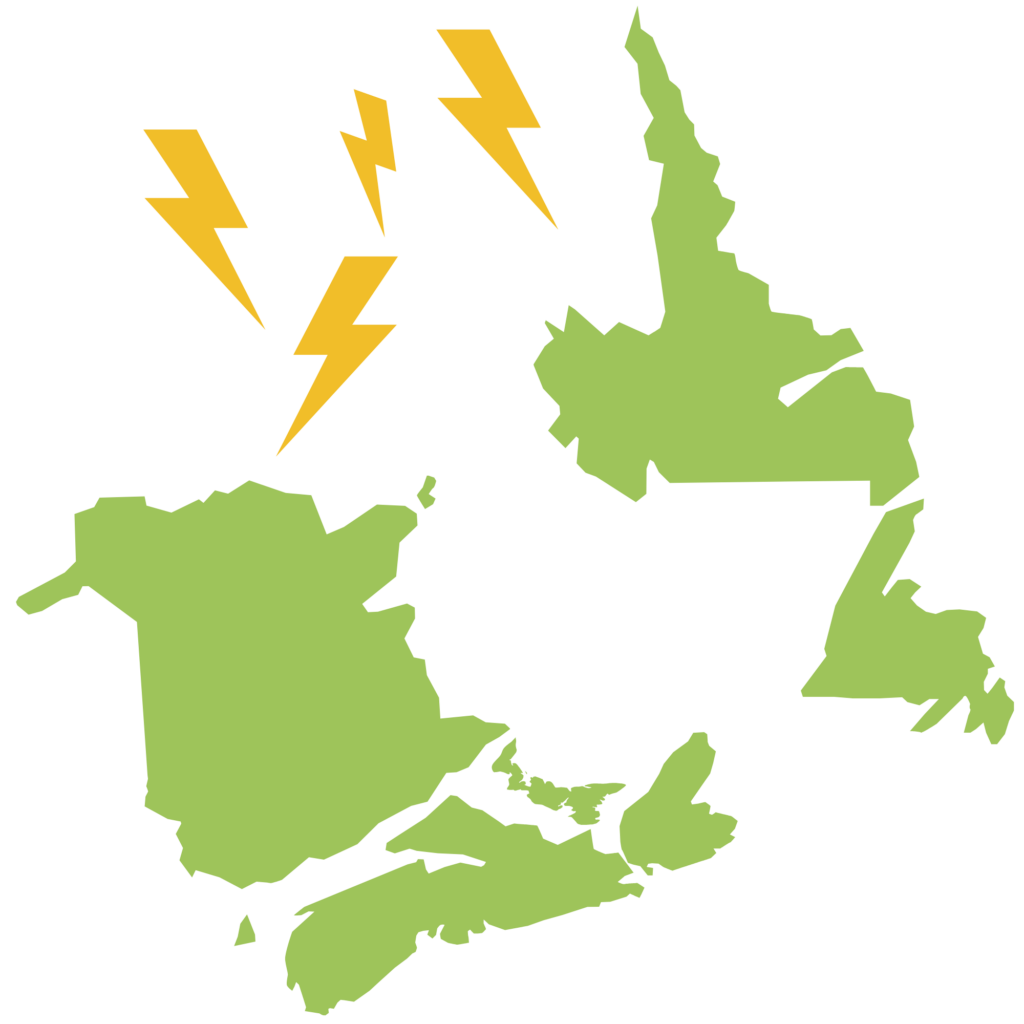
That’s the problem Wind West is really trying to solve. By pairing offshore wind development with new transmission — including projects like the proposed NB–NS interprovincial transmission line and the Wasoqonatl intertie — the plan aims to connect Atlantic wind to bigger markets: the rest of Canada, and potentially the northeastern United States. Hydro-Québec has already signalled interest in importing Atlantic wind power, which gives a sense of where this could be headed.
What to watch next
If you want a sense of whether Wind West is actually gaining momentum, a few things are worth keeping an eye on:
- The first Call for Bids — expected later this year, will be the clearest signal yet of how quickly this moves from planning to development.
- Transmission progress — without new lines, even a successful bidding round doesn't solve the "power with nowhere to go" problem.
- Federal funding decisions — through the Major Projects Office, which has already backed smaller projects like Mersey River Wind and pre-feasibility transmission studies.
The bottom line
Sixty gigawatts is a resource-potential number, not a construction timeline. What makes it meaningful isn’t the size of the figure on its own — it’s what it represents: a region with more clean energy potential than it could ever use locally, finally building the infrastructure to put that potential to work.
We’ll keep tracking this one as it develops — subscribe to get the next update when Nova Scotia’s Call for Bids opens.
About the author
Maria McGowan is the founder of Sociable Media and host of the Reimagined Energy podcast — Atlantic Canada’s independent, trusted voice on the region’s energy transition. With 30+ years of marketing and communications experience, she helps offshore wind, hydrogen, solar, and grid companies translate technical projects into stories the public can actually evaluate.
Have a project that needs this kind of explaining? Schedule a 30-minute call and let’s talk about earning public trust for your work.